Here appear occasional jottings of my random musings. Profound or jejune, they reveal the contours of my mental universe, with world history, intellectual history, civilizations, philosophy, religion, society, knowledge, and books as some major themes. Since May 2011, this blog has been exclusively focused on Singapore. All my other reflections are now posted in "Notes from Noosphere" (see link under "Miscellany" on the right margin).
Wednesday, October 6, 2010


Southeast Asia and Singapore: Crossroads of world civilizations
It is remarkable, but unremarked upon(in my experience), that Southeast Asia is at the crossroads of the four major civilizations of the world: Christian, Islamic, Indic and Sinic.
The four civilizations exercice their dominent influence in the following countries:
1. Christian (Roman Catholic): The Philippines (except Mindanao), East Timor
2. Islamic: Indonesia, Malaysia, Brunei, Mindanao (Philippines)
3. Indic
a. Theravada Buddhism: Myanmar, Thailand, Laos, Cambodia.
b. Hinduism: Bali (Indonesia)
4. Sinic: Vietnam, Singapore
Singapore, uniquely in Southeast Asia, shows the strong presence of all four civilizations.
The four civilizations exercice their dominent influence in the following countries:
1. Christian (Roman Catholic): The Philippines (except Mindanao), East Timor
2. Islamic: Indonesia, Malaysia, Brunei, Mindanao (Philippines)
3. Indic
a. Theravada Buddhism: Myanmar, Thailand, Laos, Cambodia.
b. Hinduism: Bali (Indonesia)
4. Sinic: Vietnam, Singapore
Singapore, uniquely in Southeast Asia, shows the strong presence of all four civilizations.
Cultural realms, civilizations
I have found the following conceptual framework of world civilizations by Jan Broek ("A Geography of Mankind" (1968,1973,1978), Jan O.M. Broek and John W. Webb) very useful.
A. Major civilizations:
1. Occidental (Christian)
2, Main Islamic (excluding SE Asia)
3. Indic (Hindu)
4. Sinic (East Asian)
B. Minor civilizations:
5. Southeast Asian
6. Meso-African (Negro-African, sub-Saharan African)
7. Southern Pacific (Melanesian-Polynesian)
"The Clash of Civilizations" by Samuel P. Huntington provides a more contemporary, more geo-political, framework, shown in the following map (map source: Wikipedia):


Broek's conceptual framework accommodates Huntington's nine civilizations, thus:
A, 4 Major Civilizations:
1. Christian
a. Western
b. Latin American
c. Orthodox
2. Islamic
3. Indic
a. Hindu
b. Buddhist
4. Sinic
a. Chinese-Korean-Vietnamese
b. Japanese
B. Minor Civilization:
5. Meso-African
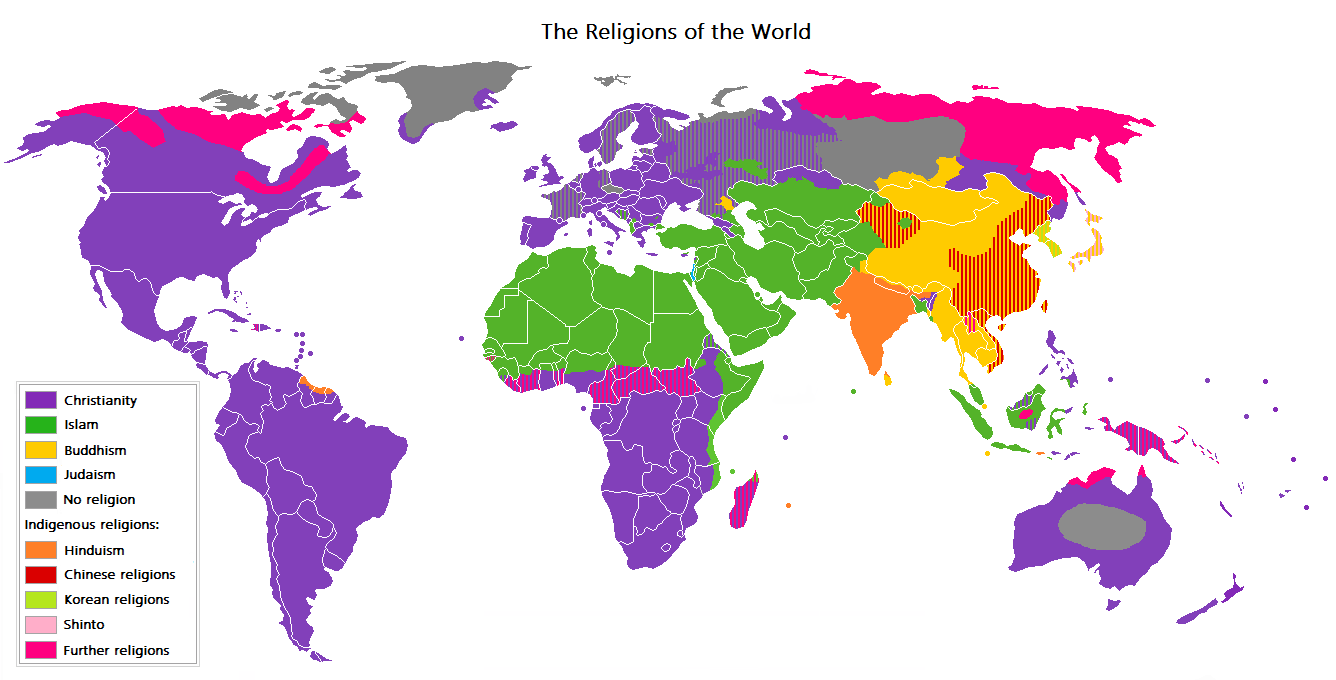
A similar view of the major civilizations can be gained by examining the spread of the major religions.

Tuesday, October 5, 2010
Cultural comparison in five dimensions (Geert Hofstede)
I have just come across Geert Hofstede's fascinating five-dimensional quantitative model of culture. Data have been collected for 66 cultures across the globe, including those of US, UK, China, Malaysia, Hong Kong, and Singapore. Ranked by Individualism, one of the five dimensions, US, Australia and UK are the top nations. Ranked by Uncertainty Avoidance, Singapore is the nation most ready for uncertainty. Surprisingly, Malaysian culture is the most willing to accept the existence of a power elite. (For analysis of the Hofstede scores of individual societies, see this.)
Reducing a culture to five numbers is inherently unsatisfactory and subjective. However, such an exercise provides a global perspective that complements the in-depth understanding of an individual culture which each person can only hope to attain for a few cultures in his/her lifetime.
The World Values Survey is a similar project that produces the interesting Inglehart–Welzel Map (map source: Wikipedia), where the vertical axis correlates strongly with Atheism, and the horizontal axis correlates strongly with Wealth. These two dimensions arose out of a factor analysis of ten variables, and account for more than 70% of the variance.

Reducing a culture to five numbers is inherently unsatisfactory and subjective. However, such an exercise provides a global perspective that complements the in-depth understanding of an individual culture which each person can only hope to attain for a few cultures in his/her lifetime.
The World Values Survey is a similar project that produces the interesting Inglehart–Welzel Map (map source: Wikipedia), where the vertical axis correlates strongly with Atheism, and the horizontal axis correlates strongly with Wealth. These two dimensions arose out of a factor analysis of ten variables, and account for more than 70% of the variance.


Monday, October 4, 2010
Tempus fugit
The passing of Balaji Sadasivan, an exact contemporary of mine at NJC, and an eminent neurosurgeon turned politician, promped thoughts of memento mori, and of the need to examine our lives.
Sunday, October 3, 2010
金砂寨 (Jinshazhai, Jinsha), our ancestral home (Part 2)
This is a further amplification of my earlier post.
There are two sources for my family genealogy. Firstly, my grandfather in 1977 copied out his branch of the Jinsha (金砂) Tan (陈) clan genealogy, which begins with my 23rd generation ancestor, born in 1204, during the Southern Song Dynasty (南宋, 1127–1279).
For a global perspective, in 1204, the Fourth Crusade, instead of fighting the Islamic forces, fought and conquered the Byzantines, pillaged Constantinople, and established the Latin Empire of Constantinople (1204-1261).
The other source is a genealogy of the entire Jinsha Tan clan, not just our branch of it, compiled in 1922. It is briefer in the biographical details of my ancestors. It has been microfilmed and deposited in the National Archives of Singapore (The microfilm is: Teo Ann Kim Sar District Tan Clan Association, microfilm NA536).
Teo Ann Kim Sar District Tan Clan Association is 潮安金砂陈氏同乡会(see 新加坡潮属团体通讯录), who presumably owns an original copy of the clan genealogy.
There are two sources for my family genealogy. Firstly, my grandfather in 1977 copied out his branch of the Jinsha (金砂) Tan (陈) clan genealogy, which begins with my 23rd generation ancestor, born in 1204, during the Southern Song Dynasty (南宋, 1127–1279).
For a global perspective, in 1204, the Fourth Crusade, instead of fighting the Islamic forces, fought and conquered the Byzantines, pillaged Constantinople, and established the Latin Empire of Constantinople (1204-1261).
The other source is a genealogy of the entire Jinsha Tan clan, not just our branch of it, compiled in 1922. It is briefer in the biographical details of my ancestors. It has been microfilmed and deposited in the National Archives of Singapore (The microfilm is: Teo Ann Kim Sar District Tan Clan Association, microfilm NA536).
Teo Ann Kim Sar District Tan Clan Association is 潮安金砂陈氏同乡会(see 新加坡潮属团体通讯录), who presumably owns an original copy of the clan genealogy.
Saturday, October 2, 2010
Richard Olaf Winstedt? a forgotten scholar
I do not remember having encountered the name of Richard Olaf Winstedt (1878-1966) before now. A scholar of Malay language and culture and Malayan history, he was an Oxonian (Magdalen, New College) and the first president (1928-31) of Raffles College, a predecessor of University of Malaya and NUS. He served in the Malayan Civil Service until his retirement.
A name that deserves to be better known in these parts of the world (Chersonesus Aurea).
A name that deserves to be better known in these parts of the world (Chersonesus Aurea).
Friday, October 1, 2010
Dartmouth and the Native Americans
A Vermont Public Radio interview with the author of "The Indian History of an American Institution: Native Americans and Dartmouth." There are far too few histories of Dartmouth.
Subscribe to:
Posts (Atom)